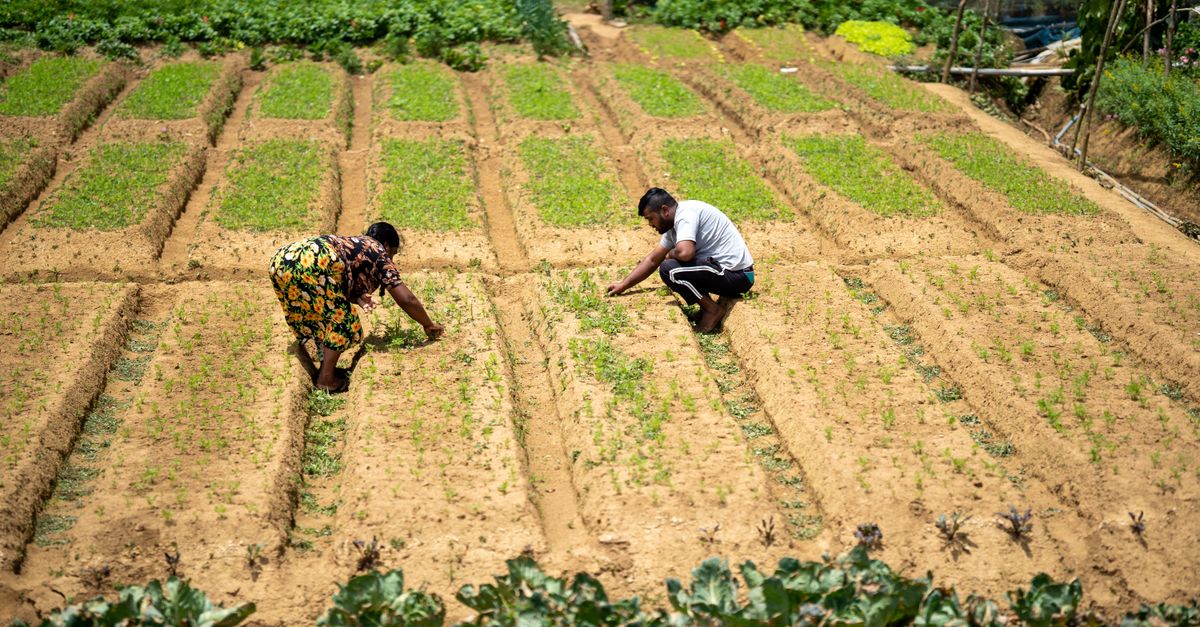
If you’ve ever typed “volunteering to meet people” into a search bar and felt slightly guilty about it (as if wanting friends out of a good deed somehow spoils the deed), you can relax. The research is on your side. Wanting to meet people is one of the most common reasons anyone volunteers, it’s one of the most reliable things volunteering actually delivers, and the evidence behind it is stronger than the evidence behind almost anything designed specifically for meeting people.
That last part is the underrated bit. There’s a whole industry of things you’re supposed to do to make friends as an adult: networking nights, singles events, speed-friending, apps. Most share a design flaw: the socialising is the entire point, so everyone stands there aware that the socialising is the entire point. Volunteering quietly sidesteps the problem. You turn up to sort food, plant seedlings or marshal a fun run, and the conversation happens on the side, while your hands are busy. Shared purpose does the work that forced mingling can’t.
Side by side beats face to face
Think about the mechanics of a mixer. You face a stranger, hold a drink, and manufacture a topic under mild time pressure. Every silence is visible. Now think about a volunteer shift. You stand next to someone packing boxes, and the task hands you the opening line for free: where does this go, how long have you been coming, is it always this busy. Silence isn’t awkward, because you’re both there to do something. Talking is optional, which is precisely what makes it easy.
Volunteering also solves the other quiet killer of adult friendship: the follow-up. Meeting someone once is cheap; seeing them again is where most new friendships stall. A regular shift builds the repeat contact in. The same Tuesday crew, week after week, without anyone having to be brave enough to suggest a second meeting. Familiarity accumulates on its own schedule.
What the research actually shows
The headline evidence comes from a Harvard-led team. Kim, Whillans, Lee, Chen and VanderWeele followed 12,998 American adults over 50 in the national Health and Retirement Study, comparing people who took up volunteering with people who didn’t, across 34 health and wellbeing outcomes (American Journal of Preventive Medicine, 2020). Those who volunteered about two hours a week (100 or more hours a year) had a 44 per cent lower risk of dying over the follow-up period, and reported less loneliness, more frequent contact with friends, more optimism and a stronger sense of purpose than non-volunteers. Not a bad return on two hours a week.
Observational studies can always be argued with, which is why the Hong Kong HEAL-HOA trial matters. Researchers took 375 adults aged 50 to 70 who were themselves screened as lonely and randomly assigned half to become volunteers, delivering telephone support to isolated older people doing it tougher than they were (The Lancet Healthy Longevity, 2024). Compared with an active control group, the volunteers became measurably less lonely, and the benefit held for as long as they kept volunteering. That’s a randomised controlled trial, the kind of evidence loneliness research rarely gets, and it points the same way as the Harvard data: helping other people is a genuinely effective way to repair your own social life.
The Australian angle: motive matters
Closer to home, a La Trobe University team surveyed Australian volunteers about loneliness and their reasons for volunteering, published in BMC Public Health in 2024. It was a small study (160 volunteers, most of them long-timers), but the pattern is worth sitting with: people whose motivation for volunteering was social, who signed up partly to be around others, reported less social loneliness. Volunteering to meet people isn’t a corruption of the good deed. It’s the mechanism working as intended.
The same researchers followed up with interviews in rural Australia, published in the Australian Journal of Rural Health in 2025 under a title borrowed from one of their participants: “Keeps me young at heart.” The through-line of those interviews is that volunteering widens social networks in a way little else does. It puts you inside a group with a shared identity, introduces you to people you’d never otherwise cross paths with, and gives you a standing reason to keep seeing them.
Perth makes this unusually easy
If you’re in Perth, you’re in one of the easiest places in the country to act on this. Western Australia volunteers at a higher rate than the nation as a whole: 65.1 per cent of the population against 56.7 per cent nationally, according to Volunteering WA’s State of Volunteering Report 2023, which counts roughly 1.5 million West Australians giving time each year. You would not be joining a niche. You’d be joining the majority.
Finding a role takes an evening, not a project plan. Volunteering WA is the state’s peak body and runs its own opportunity search, and SEEK Volunteer lists over 1,600 Perth roles at the time of writing. A few concrete shapes it can take:
Food relief. Foodbank WA’s Perth branch runs weekday shifts: working the shop front, sorting groceries, helping the mobile foodbank get food out across the metro area. No experience needed, ongoing roles, the same faces each week.
The outdoors. The Department of Biodiversity, Conservation and Attractions takes volunteers across Kings Park and Botanic Garden, Perth Zoo, wildlife rehabilitation centres and local conservation groups. Bush regeneration is the archetypal side-by-side activity: hands in the dirt, conversation optional and therefore easy.
Saturday mornings. Every parkrun in the country (more than 500 events each Saturday) runs on a small volunteer roster: timekeeper, marshal, barcode scanner, tail walker. One to two hours, no training, no fitness requirement, and the volunteers are usually at the coffee van together by 8.30am.
How to pick a role that leads to people
One caveat: not all volunteering is equally social, and if meeting people is part of your reason, it’s fine to choose accordingly. Three filters help. Pick something recurring rather than one-off. A single beach clean-up won’t compound the way a weekly shift does. Pick something done in a team rather than solo. Admin from home is generous, but nobody ever made a friend at their own kitchen table. And when the shift ends and someone floats a coffee afterwards, say yes. Those ten minutes in the café next door are where a co-volunteer starts becoming a friend. It’s also free, which is more than can be said for most of the friend-making industry.
That last step, the coffee, is the one people skip, and it’s the one that matters. It’s also where Flat White sits in the picture. The app arranges one-to-one coffees: one person, one café, one hour, on purpose. It’s really just the post-shift coffee without needing the shift first. Volunteering builds the roster of people around you; a deliberate coffee turns one of them into someone you actually know.
Meet one person. Over coffee. On purpose.
Australia’s opening city-by-city. Join the waitlist at joinflatwhite.com →